
In a new study, which was published last week in Frontiers in Oncology, scientists from Oncolines, together with researchers from Vrije Universiteit Amsterdam, describe differentiators and a potential new therapeutic application for Bruton’s Tyrosine Kinase (BTK) inhibitor nemtabrutinib [1].
Currently, four BTK inhibitors are approved for treatment of B-cell malignancies. The three approved covalent BTK inhibitors ibrutinib, acalabrutinib and zanubrutinib bind irreversibly to the active site of BTK [2]. To overcome acquired resistance at this site, reversible inhibitors pirtobrutinib and nemtabrutinib were developed. Pirtobrutinib was approved in 2023, while nemtabrutinib is in phase 3 clinical trials for B-cell malignancies [2].
Nemtabrutinib was profiled on a panel of human kinases in biochemical assays and showed inhibition on a range of kinases beyond BTK, raising the possibility of identifying new drug response biomarkers and therapeutic applications. Therefore, nemtabrutinib was profiled on a panel of 160 cancer cell lines in viability assays at Oncolines and the response data were subjected to bioinformatic analyses. Results uncovered BRAF mutation as a biomarker predictive for drug response. Furthermore, nemtabrutinib clustered together with pan-RAF, MEK and ERK inhibitors in a comparative profiling analysis indicating a similar cellular selectivity (Figure). Combined bioinformatic analyses uncovered previously underappreciated cross-reactivities and several additional kinases involved in cellular activity of nemtabrutinib, including members of the mitogen-activated protein kinases (MAPK) family. Binding and kinase enzyme activity assays confirmed that some of these kinases are direct molecular targets of nemtabrutinib.
One of the most prominent identified targets is MEK1. Molecular docking studies predicted that nemtabrutinib binds MEK1 in the ATP-binding pocket and not in the allosteric pocket. Currently approved MEK1 inhibitors bind MEK allosterically (e.g. trametinib or cobimetinib) and an ATP-competitive inhibitor may overcome resistance mutations against these inhibitors. The results in this study suggest that nemtabrutinib could be explored as an ATP-competitive MEK1 inhibitor.
This study further demonstrates that combining cellular profiling, biochemical profiling and bioinformatic analyses is a powerful approach to identify differentiators and new therapeutic applications for a kinase inhibitor.
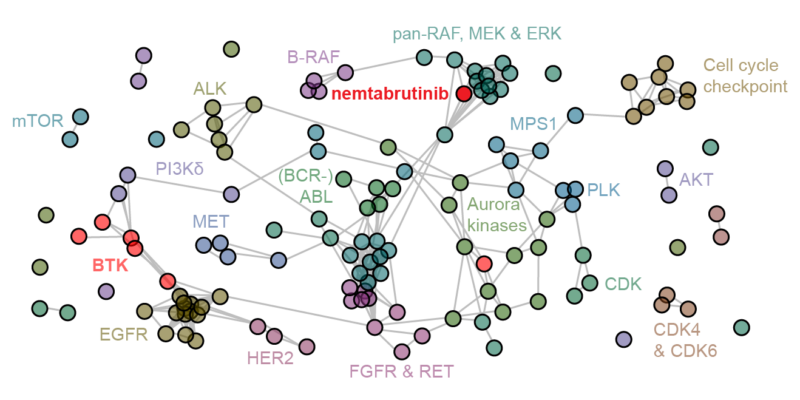
Figure | Network tree connecting inhibitors with a similar cellular inhibition profile. Nemtabrutinib clusters together with pan-RAF, MEK and ERK inhibitors.
References:
[1] Kluitmans et al. (2025). Combined cellular and biochemical profiling of Bruton’s tyrosine kinase inhibitor nemtabrutinib reveals potential application in MAPK-driven cancers. Front. Oncol. 15:1667291
[2] Eyre and Riches (2023). The evolution of therapies targeting bruton tyrosine kinase for the treatment of chronic lymphocytic leukeamia: Future perspectives. Cancers 15(9):2596
Oncolines B.V. is a precision medicine services company in oncology and cancer immunotherapy. Oncolines is part of the Symeres group of companies, a group of high-quality CROs and CDMOs based in Europe and the United States.