

Evaluation of sensitivity to WRN inhibitors in microsatellite stable and instable cells using the colony-forming unit assay
  • Microsatellite instability is a common genomic alteration found in a range of solid tumors, including colorectal cancers, and is defined by alterations in the length of repetitive DNA sequences.1,2

  • The WRN DNA helicase is essential in microsatellite instable (MSI) cells because it helps resolve replication stress caused by expanded repetitive DNA sequences.3

  • WRN inhibition leads to DNA damage and cell death specifically in MSI tumor cells, while sparing microsatellite stable (MSS) and normal cells, making WRN a promising, selective therapeutic target. 4

  • The colony-forming unit (CFU) assay is used to measure the ability of a single cell to survive treatment and retain proliferative capacity. This assay is especially useful for evaluating drugs whose effects accumulate over multiple cell cycles, such as WRN inhibitors.

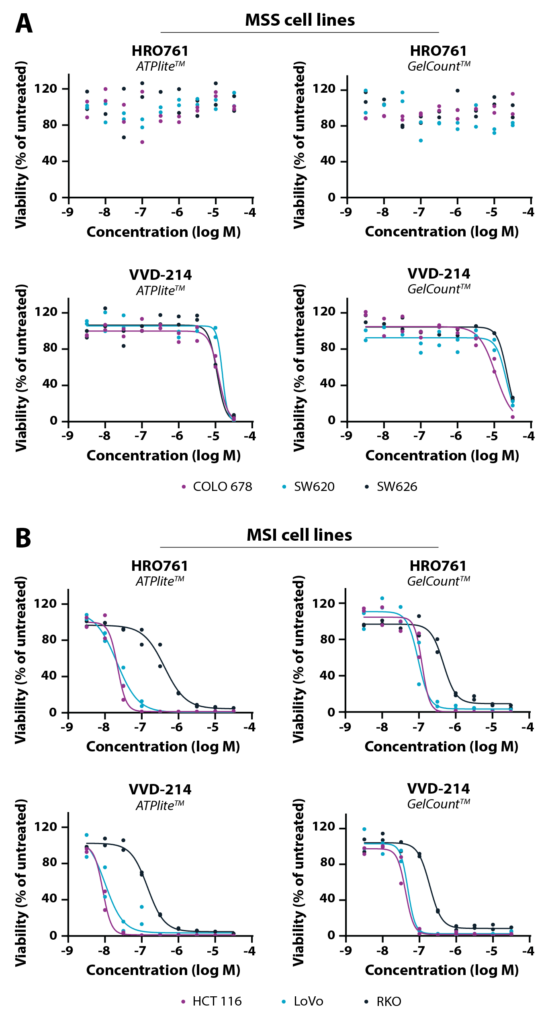
  • The WRN inhibitors HRO761 and VVD-214 were profiled in the MSS colorectal cancer cell lines COLO 678, SW620 and SW626 and the MSI colorectal cancer cell lines HCT 116, LoVo and RKO using the CFU assay.

  • Cells were treated with duplicate 9-point dose ranges of the compounds for 7-20 days, and outcomes were assessed using ATPlite™, as an indirect measure of cell number, and colony counting using a GelCount™ system.

  • The CFU assay results show a strong, dose-dependent reduction in both cell number and colony formation after WRN inhibitor treatment in MSI cells, but not in MSS cells (Figure 1 and 2).

  • These findings demonstrate loss of proliferative capacity, specifically in MSI cells, after prolonged WRN inhibitor exposure.

Figure 1 | CFU assay results of the WRN inhibitors HRO761 and VVD-214 profiled in (A) the MSS cell lines COLO 678, SW620 and SW626 and (B) the MSI cell lines HCT 116, LoVo and RKO.
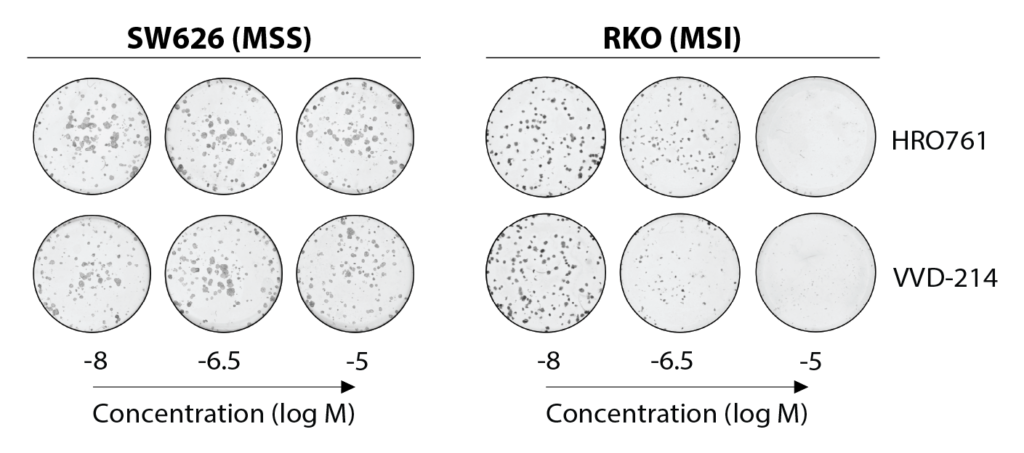
Figure 2 | Images of stained colonies from the MSS cell line SW626 (left) and the MSI cell line RKO (right) following treatment with the WRN inhibitors HRO761 and VVD-214.

References
1. Kavun et al. (2023) Microsatellite Instability: A Review of Molecular Epidemiology and Implications for Immune Checkpoint Inhibitor Therapy. Cancers (Basel). 15(8):2288.
2. de la Chapelle and Hampel (2010). Clinical relevance of microsatellite instability in colorectal cancer. Journal of Clinical Oncology. 28(20):3380-3387.
3. van Wietmarschen et al. (2020). Repeat expansions confer WRN dependence in microsatellite-unstable cancers. Nature. 586:292-298.
4. Zhang et al. (2025) WRN as a Novel Target of Synthetic Lethality: Current Advances and Future Perspectives. J. Med. Chem. 68(13):13218-13245.