

Downstream effects of specific TP53 mutations
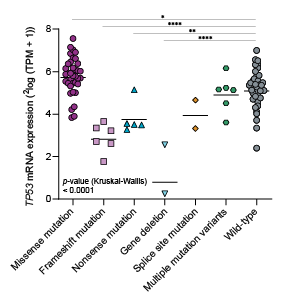
  • TP53 is one of the most frequently mutated genes in cancer and different mutations in TP53 can result in distinct downstream effects.1

  • In a TP53-dedicated mutation analysis, TP53 mutant cell lines were subgrouped based on their mutation type or mutation location in the functional domains of TP53. The groups were then related to basal gene expression levels of TP53.

  • This analysis revealed that cell lines with a TP53 truncating mutation (e.g., frameshift, nonsense, or splice site mutation) or gene deletion have lower TP53 mRNA expression (Figure 1). Contrastingly, cell lines with a missense mutation show on average a slight increase in the mRNA levels of TP53 (Figure 1).

  • Missense mutations can be further subgrouped based on their location in the functional domains of TP53. When comparing the gene expression of TP53 among these subgroups, no significant differences are found (Figure 2), suggesting that the location of a missense mutation generally does not influence TP53 expression.

  • Gene expression alone does not always reflect actual pathway activity. The different TP53 mutation types were therefore also related to p53 pathway activity. A p53 pathway score was calculated for each cell line based on a pre-defined expression signature of 90 genes.2

  • The results show that the p53 pathway score is decreased for all TP53 mutation types compared to wild-type cell lines, indicating that different TP53 mutations commonly result in decreased p53 pathway activity (Figure 3).

  • Comparing mutation status and other cell line characteristics can reveal similarities or differences in downstream effects caused by specific mutation groups.

Figure 1 | TP53 mutations and TP53 mRNA expression levels. Mutant cell lines were subgrouped based on the mutation type and the groups were related to TP53 mRNA expression for 95 cancer cell lines.
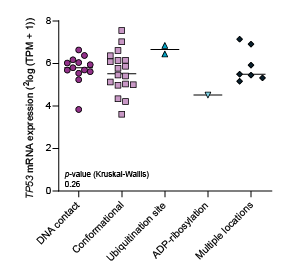
Figure 2 | TP53 mutations and TP53 mRNA expression levels. Mutant cell lines were subgrouped based on the mutation location in functional domains and the groups were related to TP53 mRNA expression.
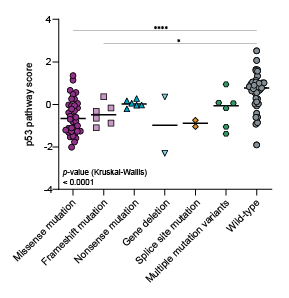
Figure 3 | TP53 mutations and p53 pathway score. The relation of TP53 mutation types and p53 pathway scores.

References:
1. Chen X., et al. (2022) Mutant p53 in cancer: from molecular mechanism to therapeutic modulation. Cell Death Dis. 13, 974.
2. Schubert, M., et al. (2018) Perturbation-response genes reveal signaling footprints in cancer gene expression. Nat Commun. 9, 20.