
The field of cancer therapy has largely revolved around small molecule inhibitors during the past several decades, allowing achievement of extraordinary breakthroughs in patient treatment. However, drawbacks of small molecule inhibitors include the limited druggable space and the frequent arising of drug resistance. Proteolysis-targeting chimeras (PROTACs), which target proteins for proteasomal degradation through proximity-induced ubiquitination, offer unique advantages over small molecule inhibitors, including their ability to target non-enzymatic functions.
In a new case study, we present the evaluation of a PROTAC targeting the cancer immunotherapy target IDO1. This target exhibits both enzymatic activity and non-enzymatic signaling, of which the latter is not inhibited by active site-targeting inhibitors. The IDO1-targeting PROTAC was synthesized using the Symeres modular toolbox platform (Figure; left), and was studied both for its ability to induce IDO1 degradation in cells (Figure; right) and for its potency to inhibit cellular IDO1 activity.
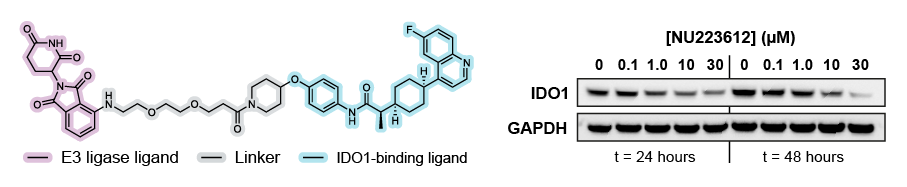
Figure | Chemical structure of the studied PROTAC (NU223612)1 (left) and PROTAC-induced degradation of target IDO1 on western blot (right).
Reference:
[1] Bollu et al. (2022). Identification and characterization of a novel indoleamine 2,3-dioxygenase 1 protein degrader for glioblastoma. Journal of Medicinal Chemistry 65, 15642–15662.
Oncolines B.V. is a precision medicine services company in oncology and cancer immunotherapy. Oncolines is part of the Symeres group of companies, a group of high-quality CROs and CDMOs based in Europe and the United States.